2.3 Kernel organization
A key design question is what part of the operating system should run in supervisor mode. One possibility is that the entire operating system resides in the kernel, so that the implementations of all system calls run in supervisor mode. This organization is called a monolithic kernel.
In a monolithic organization the entire operating system consists of a single program running in supervisor mode. One reason this organization is convenient is that the OS designer doesn’t have to divide code into parts that do and do not require supervisor privileges. Furthermore, it is easy for different parts of the operating system to cooperate, since they are parts of a single program. For example, a monolithic kernel might share a disk block cache with the file system and the virtual memory system.
A downside is that monolithic kernels tend to grow large and complex, so that no one developer understands all of the interactions between different parts of the code; this is a recipe for bugs. A bug in the kernel is particularly troublesome because it may cause the entire computer to crash, or cause many applications to malfunction, or make the entire computer vulnerable to security attacks.
A microkernel aims to reduce the incidence of bugs in the kernel. The idea is to put an absolute minimum of functionality in the kernel itself, so that little code executes in supervisor mode, and so that the kernel is easy to understand and analyze for correctness. The bulk of the operating system runs as user-level server processes. For example, the file system code would execute as a server process, in user mode rather than supervisor mode.
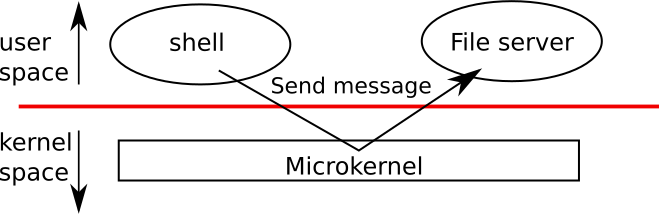
Figure 2.1 illustrates this microkernel design. In the figure, the file system runs as a user-level server process. To allow applications to interact with the file server, the kernel provides an inter-process communication mechanism to send messages from one user-mode process to another. For example, if an application like the shell wants to read or write a file, it sends a message to the file server and waits for a response.
In a microkernel, the kernel interface consists of a few low-level functions for starting applications, sending messages, accessing device hardware, etc. This organization allows the kernel to be relatively simple, as most of the operating system resides in user-level servers.
In the real world, both monolithic kernels and microkernels are popular. Many Unix kernels are monolithic. For example, Linux has a monolithic kernel, although some OS functions run as user-level servers (e.g., the window system). Linux delivers high performance to OS-intensive applications, partially because the subsystems of the kernel can be tightly integrated.
Operating systems such as Minix, L4, and QNX are organized as a microkernel with servers, and have seen wide deployment in embedded settings. A variant of L4, seL4, is small enough that it has been verified for memory safety and other security properties [sel4].
There is much debate among developers of operating systems about which organization is better, but there is no conclusive evidence one way or the other. Furthermore, it depends much on what “better” means: faster performance, smaller code size, reliability of the kernel, reliability of the complete operating system (including user-level services), etc.
There are also practical considerations that may be more important than the question of which organization. Some operating systems have a microkernel but run some of the user-level services in kernel space for performance reasons. Some operating systems have monolithic kernels because that is how they started and there is little incentive to move to a pure microkernel organization, because new features may be more important than rewriting the existing operating system to fit a microkernel design.
From this book’s perspective, microkernel and monolithic operating systems share many key ideas. They implement system calls, they use page tables, they handle interrupts, they support processes, they use locks for concurrency control, they implement a file system, etc. This book focuses on these core ideas.
Xv6 is implemented as a monolithic kernel, like most Unix operating systems. Thus, the xv6 kernel interface corresponds to the operating system interface, and the kernel implements the complete operating system. Since xv6 doesn’t provide many services, its kernel is smaller than some microkernels, but conceptually xv6 is monolithic.